What Is a Contactless Vitals App and How Does It Work?
A beginner-friendly guide to the contactless vitals app: what it measures, why no wearable is needed, and the camera science that makes touch-free readings possible.
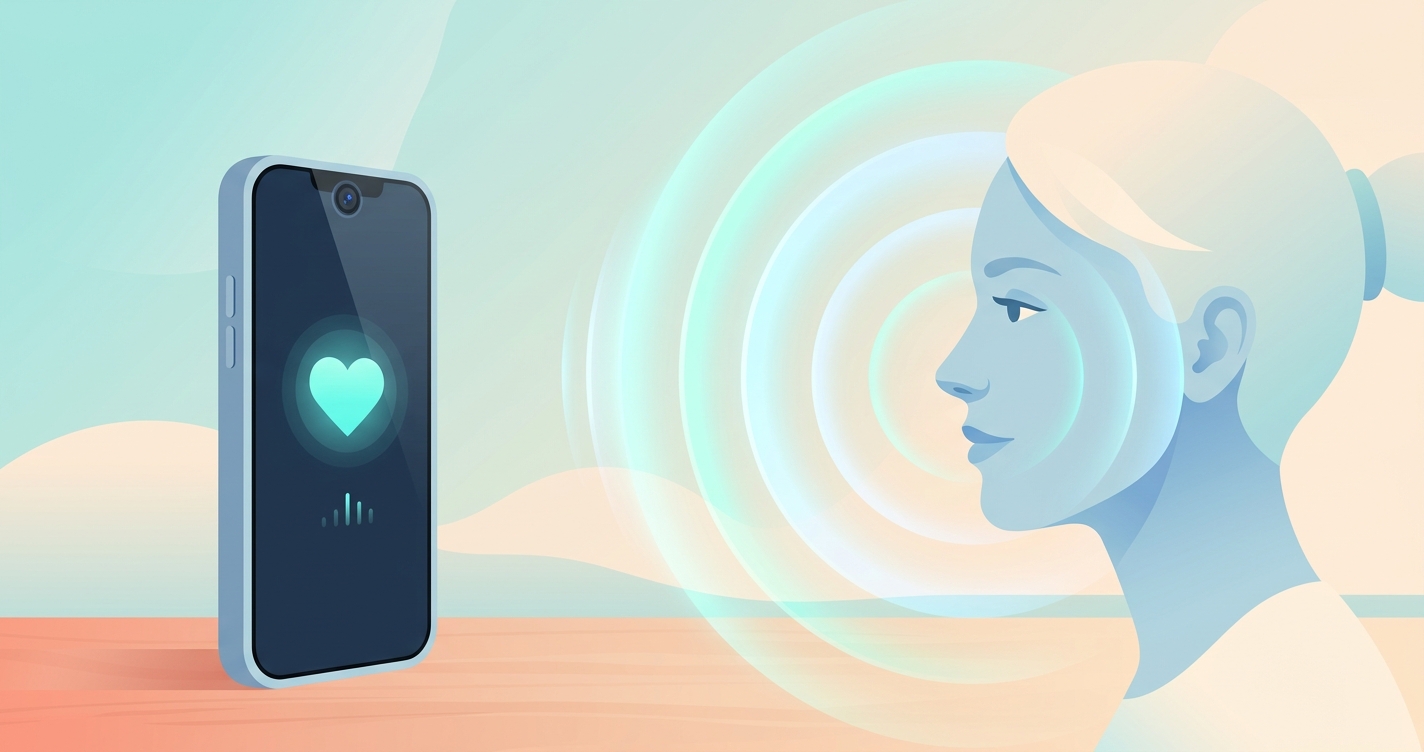
A few years ago, checking your pulse meant pressing two fingers to your wrist and watching a clock, or strapping on a wearable and waiting for it to sync. Today a growing number of people open an app, hold their phone steady for about a minute, and watch their heart rate appear on screen without anything touching their skin. That shift is what a contactless vitals app delivers: a way to measure signals your body produces every second using the camera you already carry. For anyone who is health-curious but reluctant to buy yet another gadget, it is worth understanding what these apps actually read, how they pull it off, and where the technology still has limits.
"Smartphone-based remote photoplethysmography has predicted heart rate with roughly 97 percent accuracy and respiratory rate with over 84 percent accuracy against reference devices in recent validation work, signaling that the camera in your pocket is becoming a serious measurement tool." - based on a 2023 medRxiv validation study of an rPPG-enabled smartphone application.
How a contactless vitals app works without any wearable
The short version is that a contactless vitals app turns your phone's camera into a light sensor. The longer version comes down to a technique called remote photoplethysmography, usually shortened to rPPG. Every time your heart beats, it pushes a fresh wave of blood through the tiny vessels just beneath your skin. That extra blood absorbs slightly more light, which makes your skin darken by an amount far too small for the human eye to notice. A camera, however, can pick up those micro-changes in color frame by frame.
When you point a front-facing camera at your face, the app watches a region of skin (often the forehead and cheeks, where blood flow is rich and stable) and records how its brightness rises and falls. Software then filters out noise from movement and lighting, isolates the rhythmic signal, and converts it into beats per minute. The same waveform carries more than heart rate. The subtle rise and fall of your chest and shoulders reveals breathing rate, and the spacing between individual beats reveals heart rate variability, a measure of how adaptable your nervous system is.
This is why no-touch health apps need no wearable at all. The blood, the light, and the camera do the work. There is no cuff to inflate, no clip on a fingertip, and no band on a wrist. Donghao Qiao, Farhana Zulkernine, and colleagues at Queen's University described a full pipeline for this approach in their ReViSe framework, showing how a standard phone camera feed can be processed end to end into clean vital sign estimates.
What a touchless vitals monitor can actually measure
People often assume a camera can only count a pulse. In practice, a modern touchless vitals monitor reads a small cluster of related signals from the same scan:
- Heart rate, measured in beats per minute
- Respiratory rate, the number of breaths per minute
- Heart rate variability (HRV), a stress and recovery indicator
- Estimated stress level, derived from HRV patterns
- Trend-based readings for signals like blood oxygen and blood pressure, depending on the app
It helps to see how the touch-free approach compares with the tools most people already know.
| Method | What touches you | Setup time | Best at | Main limitation |
|---|---|---|---|---|
| Contactless vitals app | Nothing | Under a minute | On-demand spot checks, no extra hardware | Sensitive to lighting and motion |
| Smartwatch / wrist wearable | Worn on wrist | Always on | Continuous background tracking | Only the wrist, must be charged and worn |
| Fingertip pulse oximeter | Clip on finger | Seconds | Quick oxygen and pulse reading | Single-purpose device |
| Clinic blood pressure cuff | Inflates on arm | A few minutes | Validated clinical reading | Requires a visit or owned device |
The contactless option trades the always-on coverage of a wearable for flexibility. You do not have to remember to wear or charge anything. The phone is already in your hand, so a reading is never more than an app away.
Why anyone can measure vitals without contact
The appeal of measuring vitals without contact is partly practical and partly about access. A wearable represents a real cost and an ongoing habit. A camera-based scan removes both barriers, which is exactly why researchers see telehealth and remote monitoring as the natural home for this technology.
A few reasons the no-touch model has gained traction:
- Accessibility: any reasonably modern smartphone can run the scan, no purchase required
- Hygiene: nothing physical is shared between users, which matters in clinical and family settings
- Comfort: there is no cuff pressure, adhesive, or skin contact to manage
- Speed: a single scan returns several metrics at once
- Repeatability: checking a trend is as easy as opening the app again tomorrow
Everyday self-monitoring
Most people use a contactless vitals app to build a personal baseline. A morning reading taken under similar conditions each day reveals what is normal for you, which makes an unusual number easier to spot. Resting heart rate and HRV in particular respond to sleep quality, stress, and early signs of illness.
Caregiving and family health
The touch-free format is useful when contact is hard. A parent can check a sleeping child without waking them, and adult children monitoring an aging parent can take a reading without disturbing rest. Because nothing touches the skin, the same phone works for everyone in the household.
Telehealth and remote check-ins
Clinicians running virtual visits increasingly want objective numbers, not just a patient's description. A scan taken during a video call gives a provider real data to work with. Researchers reviewing rPPG in 2024 highlighted lower cost, shorter visit times, and reduced infection risk as the practical drivers behind clinical interest.
Current research and evidence
The science behind contactless vitals has matured quickly. The core idea traces back to Eulerian Video Magnification, developed at MIT CSAIL in 2012, which showed that ordinary video could be processed to amplify invisible color and motion changes tied to blood flow and breathing. That work helped prove the signal was real and recoverable from standard cameras.
Validation has followed. A 2023 study published on medRxiv tested a smartphone rPPG application and reported heart rate accuracy around 97 percent, systolic blood pressure near 94 percent, diastolic around 93 percent, and respiratory rate above 84 percent when compared against reference instruments. Separately, researchers at Google developed a passive heart rate monitoring model using the front-facing camera that kept its mean absolute percentage error under 10 percent across a range of skin tones, an important step because earlier optical methods sometimes performed unevenly on darker skin.
A 2024 review in Frontiers examined how deep learning has pushed contactless physiological measurement forward, noting steady gains in handling the two stubborn problems of the field: motion and lighting. The honest caveat across this literature is consistency. Accuracy is strongest when the subject is still, the lighting is even, and the scan lasts long enough to capture a clean signal. Movement, dim rooms, and very short scans remain the main sources of error, which is why most apps coach you to hold steady in good light.
The future of contactless vitals apps
The direction of travel is toward more signals, better robustness, and tighter integration with care. Deep learning models are getting better at separating the true pulse waveform from background noise, which should narrow the gap between a quiet, ideal scan and a real-world one taken in an ordinary room. Expect continued progress on signals that are harder to estimate from a camera alone, such as blood pressure trends and blood oxygen, where current readings are best treated as directional rather than diagnostic.
Beyond the phone, the same optical principles are spreading to other cameras, from laptops to in-car and in-home systems, pointing toward a future where a wellness reading can happen passively during something you are already doing. The likely near-term outcome is not that contactless scanning replaces clinical instruments, but that it fills the long gaps between them with frequent, low-friction data that helps people and their clinicians notice change earlier.
Frequently asked questions
Do I need any special hardware to use a contactless vitals app? No. A contactless vitals app uses your phone's existing camera. There is no wearable, cuff, or finger clip to buy. You hold the phone steady, keep your face well lit, and let the scan run for roughly a minute.
How can a camera measure my heart rate without touching me? Each heartbeat sends blood through vessels under your skin, causing tiny color changes the camera can detect but your eyes cannot. Software reads those changes frame by frame and converts the rhythm into beats per minute. This technique is called remote photoplethysmography, or rPPG.
Is a contactless reading accurate? Recent validation studies report heart rate accuracy near 97 percent under good conditions, with respiratory rate and blood pressure estimates somewhat lower. Accuracy depends heavily on staying still and having even lighting. These readings are best used for wellness tracking and trends, not medical diagnosis.
What vitals can it measure? Most apps return heart rate, respiratory rate, heart rate variability, and an estimated stress level from a single scan. Some also provide trend-based estimates for blood oxygen and blood pressure, which should be read as general indicators rather than clinical measurements.
Circadify is building in this space, turning the camera you already own into a fast, no-touch way to check your vitals and watch them change over time. If you are curious to see a contactless scan work for yourself, you can try Circadify free by downloading the app and taking your first reading in about a minute.