3 Smart Alternatives to a Wearable Health Tracker (2026)
Compare three wearable health tracker alternatives for 2026, from contactless vitals apps to manual logging, for people who want health tracking without a watch.
Wearables promised effortless health tracking, yet a large share of the people who buy them quietly stop wearing them within months. The reasons are familiar: nightly charging, wrist discomfort, skin irritation, the upfront cost, and data that piles up without ever turning into something useful. That gap between purchase and habit is exactly why a wearable health tracker alternative has become a serious search category in 2026. People still want to know their heart rate, breathing, and stress trends. They just no longer accept that a $200 device strapped to the body is the only way to get there.
"One-third of American consumers who owned a wearable product stopped using it within six months," reported Endeavour Partners in its widely cited consumer wearables analysis, a finding later echoed by Gartner, which placed abandonment at roughly 30 percent.
This report looks at the three most credible options for health tracking without a watch, weighs the trade-offs each one carries, and explains why a contactless vitals app has moved to the front of the conversation for the cost- and comfort-conscious segment.
Why a wearable health tracker alternative is gaining traction
The wearable medical and consumer device market is still growing, with 2026 forecasts ranging from roughly $30 billion to $55 billion depending on how the category is defined. Growth, however, masks a retention problem. The same surveys that celebrate adoption also document boredom, friction, and devices that end up in a drawer. Researchers who study abandonment point to three recurring causes: the device stops feeling useful, the daily value is unclear, and the hardware itself becomes a chore to maintain.
A wearable health tracker alternative tries to remove the friction rather than add a new gadget. Broadly, the people leaving wearables fall into three groups, and each maps to a different replacement strategy:
- Cost-driven users who never wanted to spend on hardware in the first place.
- Comfort-driven users who dislike wearing something on the wrist or who react to the band.
- Maintenance-driven users who are tired of charging, syncing, and firmware updates.
The question is not whether you can live without a wrist device. It is which alternative actually delivers a number you trust, with the least effort. The three contenders below are the contactless vitals app, the spot-check medical device, and the manual or behavioral logging approach.
Comparing the three main alternatives
| Alternative | Upfront cost | Daily friction | What it measures | Best for |
|---|---|---|---|---|
| Contactless vitals app (phone camera) | Free to start, no hardware | Very low, 30 to 60 second scan | Heart rate, HRV, respiratory rate, stress indicators | People wanting frequent, no-cost, on-demand readings |
| Spot-check medical devices (cuff, oximeter) | $30 to $120 per device | Medium, must locate and apply device | One metric per device, clinically familiar | People tracking a single diagnosed condition |
| Manual and behavioral logging | Free | High, fully self-reported | Symptoms, mood, activity, sleep notes | People who prefer journaling over instruments |
Each row reflects a genuine trade-off. The contactless vitals app wins on cost and friction but depends on a good scan environment. Spot-check devices are familiar and condition-specific but only measure one thing each and still require purchase and storage. Manual logging costs nothing and captures context no sensor can, but it produces no objective vital signs.
Industry applications across user segments
The contactless vitals app as a phone health monitor
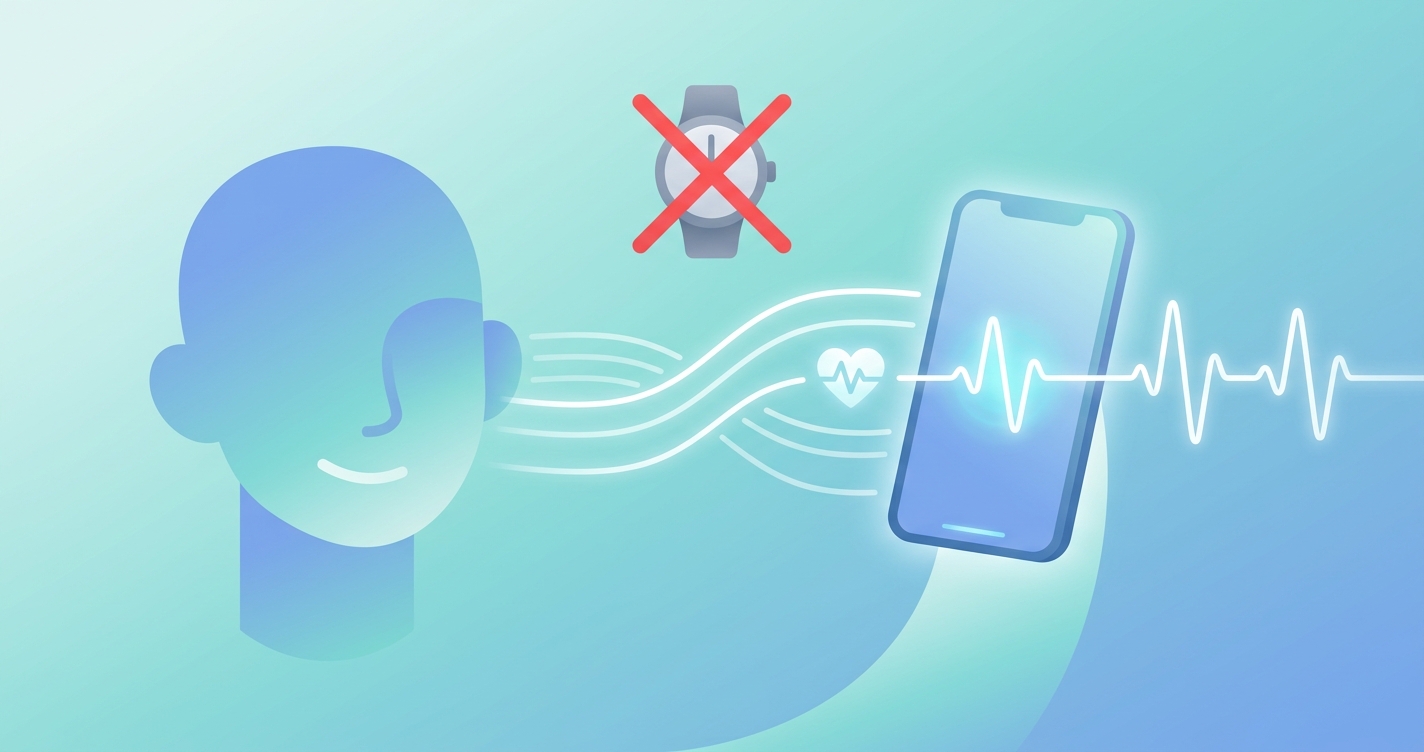
The standout option uses your phone as a health monitor through a technique called remote photoplethysmography, or rPPG. The front camera detects tiny color changes in the skin of your face caused by blood flow, and software converts that signal into heart rate, heart rate variability, respiratory rate, and stress estimates. There is nothing to wear and nothing to charge beyond the phone you already carry.
The appeal for the cost-conscious segment is direct: a contactless vitals app has a no-cost entry point, so the barrier that drove people away from wearables disappears. For people who track casually, taking a 30 to 60 second reading in the morning is lower effort than remembering to charge a band overnight and keep it on all day.
Spot-check devices for single-condition tracking
A blood pressure cuff or a fingertip pulse oximeter remains the right tool when a clinician has asked someone to watch one specific number. These devices are inexpensive individually and are trusted by users who grew up with them. The limitation is fragmentation. Each metric needs its own device, each device needs to be found and applied, and none of them produce a continuous picture. For broad wellness curiosity rather than a diagnosed condition, the overhead adds up quickly.
Manual logging for context and habit
The oldest alternative still has a place. Journaling sleep quality, mood, caffeine, and symptoms captures the kind of context that no optical sensor records. The cost is zero and the privacy is total. The weakness is obvious: self-reported notes are not vital signs, and human memory is unreliable. Many people pair manual notes with one objective input, which is where a quick camera scan complements rather than replaces a journal.
Current research and evidence
The credibility of the contactless approach rests on a maturing body of peer-reviewed work. Google Research described a smartphone camera system for passive heart health monitoring developed between 2020 and 2024, reporting a mean absolute percentage error of 6.09 percent for heart rate and a mean absolute error of 4.39 beats per minute for daily resting heart rate, results the team described as comparable to wearable-level accuracy across diverse skin tones. A 2023 evaluation of an rPPG application published on medRxiv reported around 97 percent heart rate accuracy in normotensive adults. Separately, work published in EP Europace (Oxford Academic) validated smartphone photoplethysmography for rhythm monitoring in atrial fibrillation patients in real-world conditions, while noting it can underestimate higher heart rates.
Researchers are candid about the limits. Measurement success drops in very low light, and head motion or talking during a scan introduces error. Darker skin tones have historically shown lower success rates, a gap that newer models and optimized camera exposure are actively narrowing. The honest summary is that a contactless reading taken in good conditions, at rest, is well suited to trend tracking, even if it is not a replacement for clinical diagnosis. That distinction matters for anyone choosing a wearable health tracker alternative for everyday curiosity rather than medical decisions.
The future of contactless health tracking
Three shifts are likely to define the next few years. First, passive measurement: instead of a deliberate scan, vitals may be captured during ordinary phone use such as a video call or face unlock, which removes nearly all remaining friction. Second, multi-metric scans: a single camera session increasingly returns heart rate, HRV, respiratory rate, and stress together, closing the gap with multi-sensor wearables. Third, fairness and validation: as datasets diversify, accuracy across skin tones, ages, and lighting conditions will keep improving, which is the prerequisite for broader trust.
The combined effect is that the cost and comfort objections that pushed people away from wearables map almost perfectly onto the strengths of camera-based tracking. The hardware you already own becomes the sensor, and the entry price falls to zero. That is a structural advantage, not a temporary one.
Frequently asked questions
What is the best wearable health tracker alternative if I hate charging devices? A contactless vitals app is the natural fit. It runs on the phone you already charge, so there is no extra device to maintain. You take a short scan when you want a reading rather than wearing and powering something around the clock.
Can health tracking without a watch be accurate? For at-rest, on-demand readings, yes. Peer-reviewed studies of smartphone rPPG report heart rate accuracy within single-digit percentage error under good conditions. Accuracy depends on adequate lighting and staying still, and these tools are intended for trend tracking rather than clinical diagnosis.
How does a contactless vitals app actually measure my heart rate? It uses remote photoplethysmography. The camera detects subtle color changes in your skin caused by blood flowing with each heartbeat, and software translates that signal into heart rate and related metrics like respiratory rate and stress.
Is using my phone as a health monitor free? Many contactless vitals apps offer a no-cost entry point, which is a major reason this option appeals to people who left wearables over price. You can take readings without buying any hardware.
If you have moved away from wrist devices but still want a clear read on your body, this is the moment to test the contactless route directly. Circadify is building in exactly this space, turning the front camera into a quick, no-hardware way to check your vitals. You can try contactless vitals scanning free and see whether a phone-based reading fits your routine at circadify.com/download.