5 Signs Your Stress Is Showing in Your Vitals Today
The signs of stress in vital signs show up in heart rate, HRV, and breathing before you consciously feel them. Here is what a quick phone scan can flag.
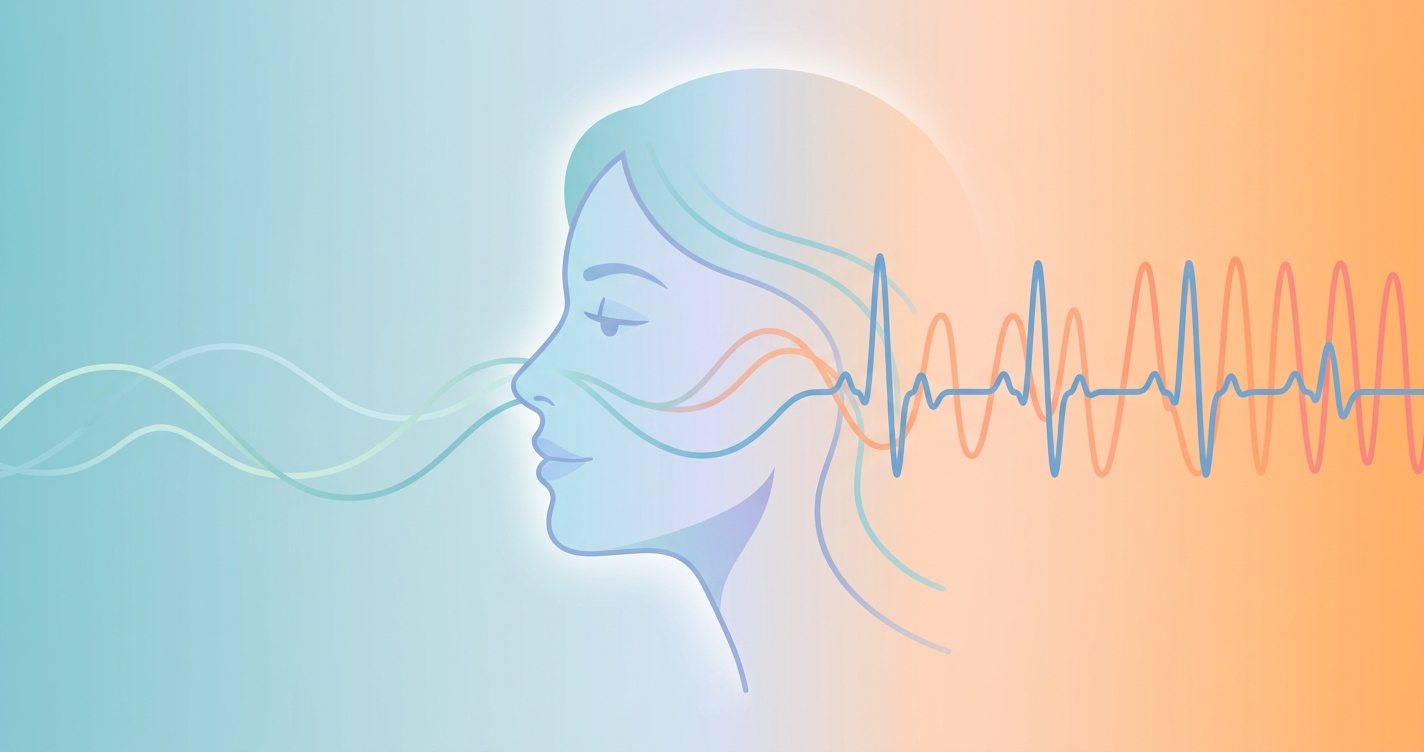
Stress rarely announces itself in plain language. It shows up first in the body, in the rhythm of your heartbeat and the pace of your breath, often hours before your mind registers that anything is wrong. The signs of stress in vital signs are measurable, repeatable, and increasingly visible through nothing more than a smartphone camera pointed at your face. That shift matters because the body's stress response is a physiological event long before it becomes an emotional one, and the earliest evidence lives in numbers most people never think to check.
For decades, reading those numbers meant a chest strap, a finger clip, or a clinic visit. Now remote photoplethysmography, the camera technique that detects tiny color changes in your skin as blood pulses through it, can surface the same signals during a 60-second scan. The interesting part is not the gadgetry. It is that your autonomic nervous system leaves fingerprints on your vitals, and once you know what to look for, those fingerprints become a quiet early-warning system.
A 2018 meta-analysis by Hye-Geum Kim and colleagues at Soonchunhyang University, reviewing 37 studies, found that psychological stress is consistently associated with reduced heart rate variability, making HRV one of the most reliable physiological markers of the stress response.
The signs of stress in vital signs worth watching
When the sympathetic nervous system activates, it does so as a coordinated cascade. The heart speeds up, the spacing between beats grows more uniform, breathing quickens and shallows, and peripheral blood flow shifts. None of these changes require a panic attack to appear. Low-grade, chronic stress nudges the same dials, just more subtly. Here are the five signals that surface most reliably.
- A resting heart rate that climbs above your personal baseline, often by 5 to 15 beats per minute under acute stress
- A drop in heart rate variability, the beat-to-beat timing variation that reflects how flexibly your nervous system adapts
- A faster respiratory rate, frequently rising from a calm 12 to 16 breaths per minute toward 18 to 22 under load
- Shallower, more chest-driven breathing that reduces the natural coupling between breath and heartbeat
- A slower physiological recovery, meaning your numbers stay elevated long after the stressor has passed
The first three are the headline signs of stress in vital signs because they are the easiest to capture without contact and the most studied. The last two are subtler but often more telling, because they describe how stress lingers rather than how it spikes.
| Vital sign | Calm baseline | Stress response | What the change reflects |
|---|---|---|---|
| Resting heart rate | 55 to 75 bpm | Elevated 5 to 15 bpm | Sympathetic activation, adrenaline release |
| Heart rate variability (HRV) | Higher, individual | Measurably lower | Reduced parasympathetic (vagal) tone |
| Respiratory rate | 12 to 16 breaths/min | 18 to 22 breaths/min | Increased oxygen demand, arousal |
| Breathing depth | Diaphragmatic | Shallow, chest-led | Weakened heart-breath coupling |
| Recovery time | Minutes | Prolonged elevation | Impaired autonomic flexibility |
How stress affects vitals at the physiological level
To understand why these signals are trustworthy, it helps to look at the mechanism. The autonomic nervous system runs two opposing branches: the sympathetic "fight or flight" system and the parasympathetic "rest and digest" system. Stress tips the balance toward the sympathetic side. That tilt is exactly what HRV measures. When parasympathetic tone is strong, the gaps between heartbeats vary naturally; when stress dominates, those gaps become more rigid and uniform.
A 2021 randomized cross-over trial led by researchers studying acute psychosocial stress confirmed that laboratory stressors reliably suppress vagally mediated HRV, and that verbal stressors in particular alter HRV partly through changes in breathing pattern. This is the link most people miss: respiration and heart rhythm are coupled. When stress speeds and shallows your breath, it directly disrupts the rhythm of your pulse. That is why breathing rate and HRV tend to move together, and why a tool that reads both at once paints a fuller picture than either alone.
Why a single reading is not the whole story
A heart rate of 80 means little in isolation. The same number could reflect a calm afternoon for one person and meaningful arousal for another. The signal lives in the deviation from your own baseline, which is why trend tracking beats one-off measurement. A 2024 review of anxiety research reinforced that reduced HRV is a marker of stress and anxiety disorders, but the clinical value comes from observing the pattern over days, not a single snapshot. This is the core argument for a phone stress check app that you can use repeatedly without friction.
Industry applications of camera-based stress signals
The same physiology that makes stress visible to a clinician is now being applied across consumer and professional settings using contactless tools.
Consumer wellness and self-monitoring
For health-curious individuals, the appeal is immediacy. A quick facial scan during a stressful workday can surface a heart rate spike or an HRV dip that the person had rationalized away. This is the everyday use case: noticing the body's stress heart rate signs before they accumulate into burnout or sleep disruption.
Workplace and performance settings
Organizations focused on employee wellbeing have begun exploring contactless stress screening as a low-barrier alternative to wearables, which not everyone wants to wear. Because a camera-based scan requires no device on the body, it lowers the friction of regular check-ins.
Research and mental health support
Photoplethysmography-based HRV analysis combined with machine learning is being studied for real-time stress quantification in mental health applications, offering a scalable way to gather physiological context that self-report surveys miss.
Current research and evidence
The evidence base for reading stress from vitals is mature; the newer frontier is doing it without contact. A 2023 analysis of pulse rate variability derived from remote photoplethysmography reported correlation coefficients between 0.98 and 1.0 against contact sensors for several temporal and frequency parameters, suggesting camera-derived signals can closely track the HRV metrics that matter for stress.
On the detection side, a 2023 study published through the National Institutes of Health database, "Enhancing Stress Detection: A Comprehensive Approach through rPPG Analysis and Deep Learning Techniques," reported stress versus non-stress classification accuracy as high as 95.83 percent using facial video and deep learning models. Independent reviewers add important caveats: accuracy of remote photoplethysmography drops at elevated heart rates and in poor lighting, and individual-level HRV estimates remain harder than group-level trends. The honest reading of the literature is that contactless stress signals are genuinely informative for tracking your own patterns over time, while precise clinical-grade HRV under all conditions is still a work in progress.
It is worth stating plainly: a phone scan is a wellness and awareness tool, not a diagnosis. It flags patterns worth attention. It does not replace a clinician.
The future of stress detection in vital signs
Three trends are shaping where this goes next. First, baseline personalization. As scans accumulate, the meaningful comparison becomes you-versus-you rather than you-versus-a-textbook-average, which sharpens the signal dramatically. Second, multi-signal fusion. Combining heart rate, HRV, and respiratory rate into a single stress index is more robust than any one metric, mirroring the way the body actually responds. Third, ambient and passive sensing, where a brief camera check becomes a routine part of a morning or midday habit rather than a deliberate medical act.
The likely destination is not a single dramatic readout but a quiet, continuous sense of your own autonomic rhythm, built from short scans woven into ordinary moments. The technology is moving from "can a camera measure this" to "how do we make the measurement useful, repeatable, and private enough that people actually trust it."
Frequently asked questions
Can a phone camera really detect stress? A phone camera can detect the physiological signals associated with stress, primarily heart rate, heart rate variability, and respiratory rate, using remote photoplethysmography. It infers stress from those vital signs rather than reading emotion directly, and accuracy improves when you track trends against your own baseline over time.
What is the most reliable vital sign for stress? Heart rate variability is widely considered the most reliable single marker, supported by a 2018 meta-analysis of 37 studies showing consistently reduced HRV under psychological stress. Combining HRV with heart rate and breathing rate gives a stronger picture than any one signal alone.
How quickly do vitals change under stress? The autonomic response is fast, often within seconds to a minute of a stressor. Heart rate and breathing rise almost immediately, while a slower return to baseline after the stressor passes can itself be a sign of accumulated or chronic stress.
Is a phone stress check a substitute for seeing a doctor? No. A phone stress check app is a self-awareness and wellness tool that helps you notice patterns. It does not diagnose anxiety, heart conditions, or any medical issue. Persistent elevated readings or symptoms should be discussed with a healthcare professional.
Circadify is building toward exactly this kind of effortless, contactless stress awareness, turning the camera you already carry into a quiet check on how your body is handling the day. If you want to see what your own vitals say right now, you can try a free Circadify stress scan and start tracking the signals that show up long before you feel them.