Signs of High Stress You Can Spot From Your Phone
Learn the physical signs of high stress your phone can flag through your heart rate, HRV and breathing, and what those vitals actually mean.
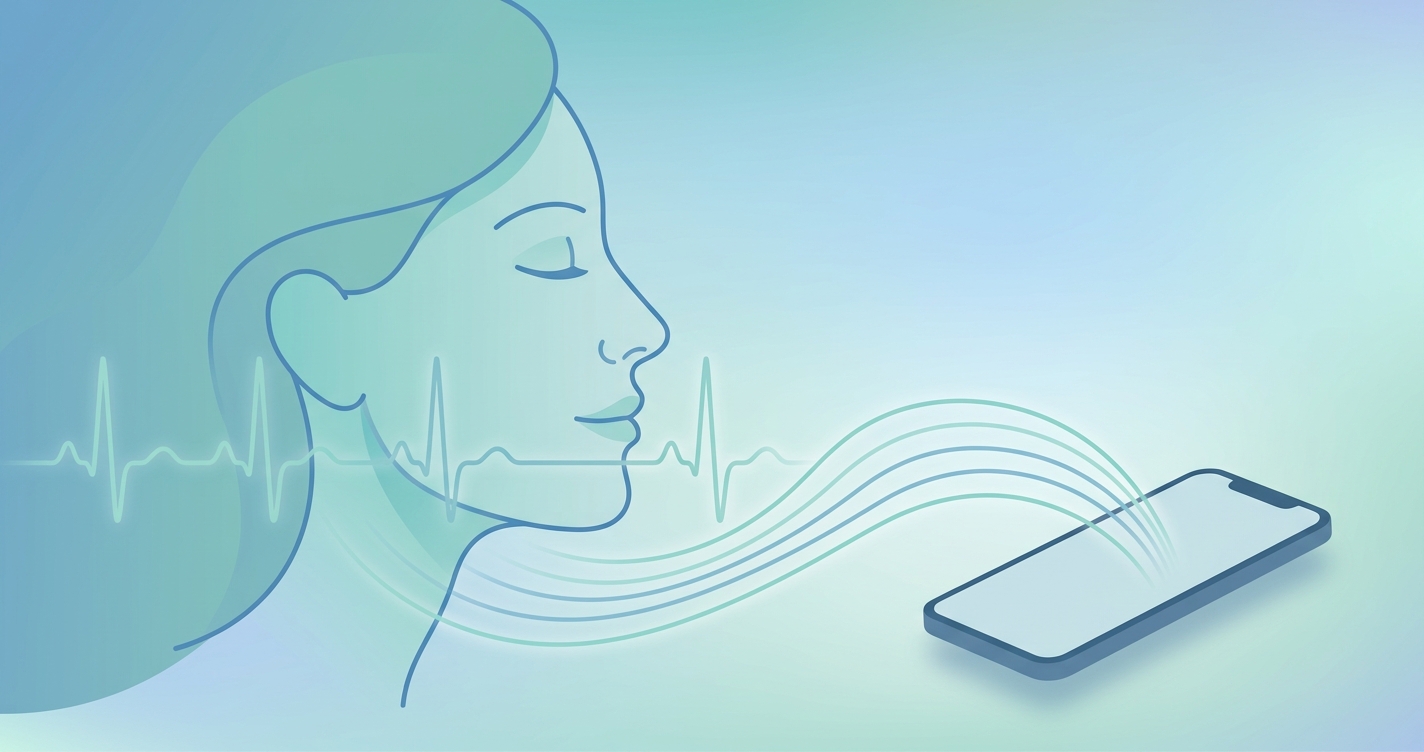
Most people learn to recognize stress by how it feels: the tight chest before a meeting, the restless night, the short temper by Friday. What fewer people realize is that the body keeps a quieter, more reliable record. Before you consciously register tension, your autonomic nervous system has already adjusted your heart rate, narrowed the gaps between beats, and quickened your breathing. The signs of high stress are physiological events first and emotions second, which is exactly why a smartphone camera, pointed at your face for sixty seconds, can now surface them. This shift matters for anyone who tends to dismiss their own worry until it becomes overwhelming, because it turns a vague feeling into something measurable.
A 2024 meta-analysis of heart rate variability research found that stress is consistently associated with reduced HRV and lowered parasympathetic activity, making it one of the most established physiological markers of the human stress response.
The signs of high stress hidden in your vitals
When researchers talk about stress, they are describing a coordinated response run by the autonomic nervous system. The sympathetic branch, the so-called fight-or-flight system, speeds the heart, raises blood pressure, and tightens breathing. The parasympathetic branch, which governs rest and recovery, gets suppressed. The signs of high stress that your phone can flag all trace back to this seesaw between the two branches.
Three vitals carry most of the signal:
- Heart rate. Acute stress raises resting heart rate as the sympathetic system accelerates the heart. A reading that sits noticeably above your personal baseline at rest is a common early flag.
- Heart rate variability (HRV). This measures the tiny timing differences between consecutive beats. High variability generally reflects a relaxed, adaptable nervous system. When stress rises, those gaps become more uniform and HRV drops. It is one of the most sensitive stress signs in vitals.
- Respiratory rate. Stress tends to push breathing faster and shallower, often before you notice it.
Camera-based measurement reads these through remote photoplethysmography, or rPPG. The technique detects subtle color changes in facial skin caused by blood flowing with each heartbeat. From that pulse signal, software can derive heart rate, estimate HRV, and track breathing patterns. A 2024 review from the University of St Andrews described rPPG as a non-invasive way to measure heart rate, respiration, and HRV from ordinary camera footage, no contact required.
How different stress signals compare
Not every stress signal behaves the same way, and understanding the differences helps you read a phone stress check sensibly rather than panicking over a single number. The table below summarizes how each marker responds and how quickly a phone can pick it up.
| Stress signal | Direction under stress | How fast it responds | Phone detectability via camera | Best read as |
|---|---|---|---|---|
| Resting heart rate | Increases | Minutes | High | A trend over days |
| Heart rate variability (HRV) | Decreases | Minutes to hours | Moderate to high | Morning baseline comparison |
| Respiratory rate | Increases, shallower | Seconds to minutes | Moderate | In-the-moment check |
| Blood pressure trend | Tends to rise | Minutes | Emerging | Long-term pattern |
| Skin/facial blood flow | Shifts | Seconds | Moderate | Supporting signal |
The practical takeaway is that no single reading defines your stress. Heart rate and respiratory rate react quickly and suit a real-time check, while HRV is most useful when you compare a calm morning measurement against your own normal range over weeks.
Why a phone can detect stress at all
The idea that detecting stress with a phone is possible rests on decades of physiology, not novelty. The link between HRV and stress is well documented. Work compiled in PubMed Central, including the WESAD dataset analysis, has shown that machine learning models using HRV features such as pNN50 and mean inter-beat interval can distinguish stress from rest states with high accuracy in controlled settings. Those same features can be approximated from a camera-derived pulse signal.
What makes phones newly capable is the combination of better front-facing cameras, faster processors, and signal-processing methods refined on public research datasets. A camera does not need to touch you to see the rhythmic flush of blood under the skin. It only needs reasonable light, a still face, and a clear view.
What the camera actually sees
Each heartbeat sends a pulse of blood through the capillaries in your face. That changes how much light your skin reflects by an amount invisible to the human eye but detectable to a sensor analyzing video frame by frame. Stress shows up as a faster pulse, more rigid beat-to-beat timing, and a breathing rhythm layered on top of the pulse waveform.
Where it works best, and where it struggles
Lighting, skin tone, and movement all affect quality. Researchers continue to flag sensitivity to ambient light, varied skin pigmentation, and motion artifacts as the main accuracy challenges for rPPG. A scan in even, indoor light while holding still gives the cleanest read on your stress and heart rate. A scan while walking under flickering light gives a noisier one.
Industry Applications
Personal wellness and self-monitoring
The most direct use is everyday self-awareness. Someone prone to anxiety can run a phone stress check before a presentation, note an elevated heart rate and suppressed HRV, and use that as a cue to breathe deliberately or step away. Over weeks, the data reveals patterns: which days, habits, or sleep durations precede high-stress readings.
Workplace and occupational health
Employers and occupational-health programs are exploring contactless screening because it scales without distributing hardware. A camera-based check can be offered through software employees already have, supporting voluntary stress and burnout awareness initiatives without the cost of wearables for an entire workforce.
Telehealth and remote care
Clinicians conducting video visits gain a channel that previously did not exist. Estimating respiratory rate and pulse during a remote consultation adds context to a conversation that would otherwise rely entirely on what a patient reports.
Current research and evidence
The evidence base sits at the intersection of two mature fields: stress physiology and remote sensing. On the physiology side, the 2024 HRV meta-analysis reinforced that reduced HRV reliably tracks with stress, and studies in mid-life adults have connected HRV patterns to cortisol responses, the hormonal signature of stress.
On the sensing side, progress is fast. A 2024 study published in PMC, "Enhancing Stress Detection: A Comprehensive Approach through rPPG Analysis and Deep Learning Techniques," reported stress-detection accuracy as high as 95.83 percent on the UBFC-Phys dataset using hybrid deep learning networks applied to facial video. Separately, Samsung Research published a 2024 multimodal method for estimating breathing rate from facial motion and rPPG using an ordinary RGB camera, reaching a mean absolute error of about 1.33 breaths per minute.
A reasonable reading of this body of work: the relationship between vitals and stress is solid, and camera-based estimation of those vitals is improving quickly, though real-world conditions remain harder than curated datasets. None of these tools diagnose anxiety disorders or replace a clinician. They surface physiological signals that correlate with stress, which is a meaningful first step for someone trying to understand their own body.
The future of phone-based stress detection
Three trends are shaping where this goes. First, multimodal fusion: combining pulse, HRV, respiration, and facial cues into a single, more robust stress estimate rather than relying on one marker. Second, longitudinal baselining, where the value comes not from a one-off number but from how today compares to your own history. Third, accessibility, as contactless methods reach people who would never buy a wearable, including older adults and those simply curious about their health.
The likely destination is ambient, low-friction stress awareness: a quick face scan becoming as ordinary as checking the weather, giving people an early, honest signal about a state they often ignore until it costs them sleep or health.
Frequently asked questions
Can my phone really detect stress without a wearable?
It can estimate the physiological markers associated with stress, mainly heart rate, heart rate variability, and respiratory rate, using the front camera and rPPG. Research has shown these signals correlate strongly with stress, though a phone reading reflects your body's state, not a clinical diagnosis.
What heart rate counts as a sign of high stress?
There is no universal cutoff because resting heart rate varies by person. The more useful signal is a reading clearly above your own baseline at rest, especially when paired with reduced HRV and faster breathing. Tracking your normal range over time makes a single elevated reading interpretable.
Is HRV or heart rate the better stress signal?
They tell you different things. Heart rate reacts fast and suits an in-the-moment check, while HRV is more sensitive to your overall stress balance and is best read as a morning baseline you compare against yourself over weeks. Used together, they give a fuller picture than either alone.
Should I worry if one scan shows high stress?
A single reading is a snapshot, not a verdict. Caffeine, poor sleep, movement, and even lighting can affect it. Look for repeated patterns over days, and if elevated stress signals persist alongside how you feel, that is a reasonable prompt to talk with a healthcare professional.
Circadify is building toward exactly this kind of accessible, contactless stress awareness, letting you read your vitals with the camera you already carry. If you want to see what your own numbers say, you can try a free scan at circadify.com/download and start spotting the signs of high stress before they catch up with you.