
Does a Phone Health Scanner Work in the Dark at Night?
Does a phone health scanner work in dark or dim rooms? We break down how lighting affects rPPG accuracy and share practical tips for a reliable night scan.
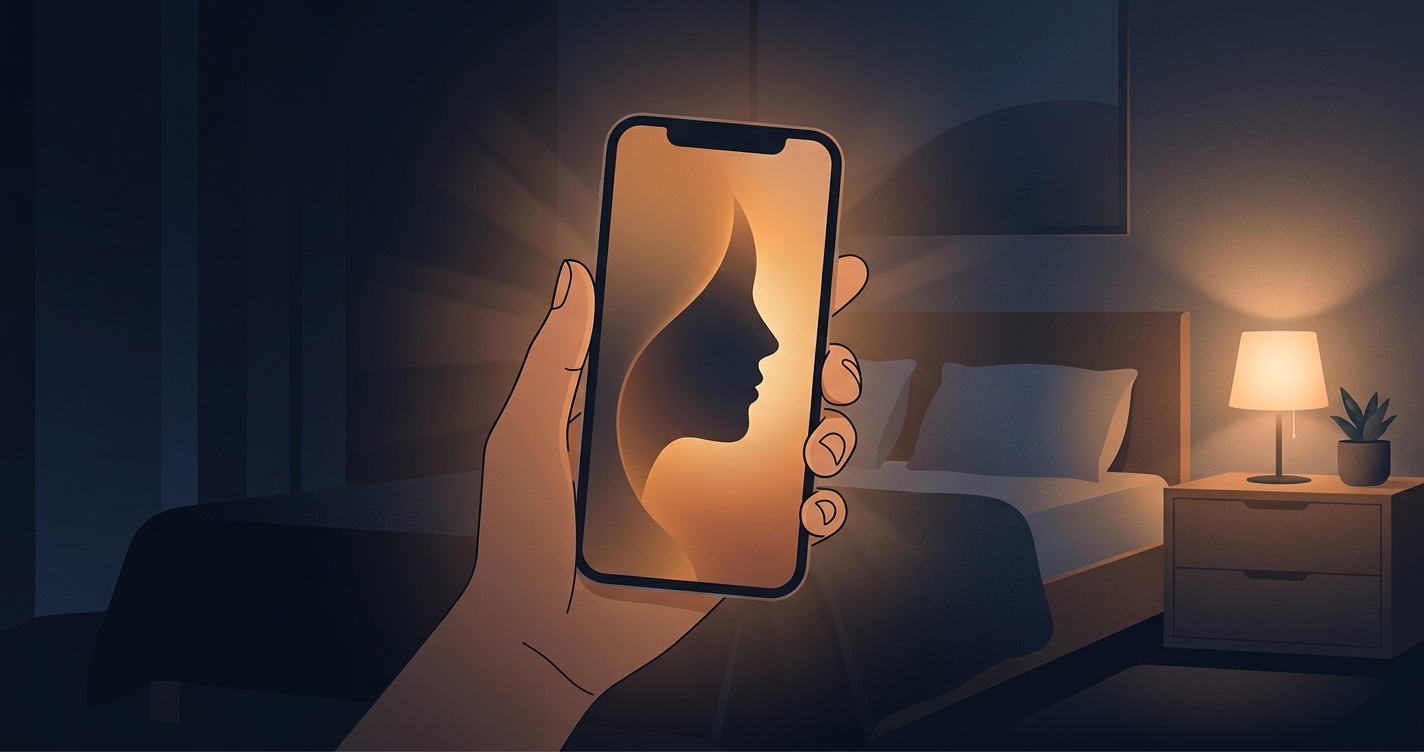
If you have ever opened a vitals app at 2 a.m. to check your heart rate without flipping on a lamp, you have run straight into one of the technology's most honest limitations. The short answer to whether a phone health scanner works in dark conditions is: partly, but not well, and understanding why turns out to be a quick lesson in optics. Camera-based scanning depends on the camera actually seeing tiny color shifts in your skin. Take away the light, and you take away the data. This question matters because so many people reach for these tools exactly when the lights are low: late at night, in a dim bedroom, or beside a sleeping family member.
"Low illumination conditions can lead to decreased signal fidelity in remote photoplethysmography measurements, making accurate heart rate estimation challenging.", findings summarized from peer-reviewed rPPG reliability research, 2025
Why a phone health scanner struggles to work in the dark
The technology behind a camera health check app is called remote photoplethysmography, or rPPG. When your heart beats, it pushes a pulse of blood through the vessels just under your skin. That blood very slightly changes how your skin absorbs and reflects light, mostly in the green part of the spectrum. The phone camera records these micro-changes across hundreds of frames, and an algorithm reconstructs your pulse waveform from the pattern.
That entire process is built on reflected light. In a dark room, there is almost nothing for the sensor to work with. The signal that carries your pulse gets buried under camera noise, the same grainy speckle you see when you try to photograph a dim scene. Researchers studying rPPG in low light have repeatedly found that as illumination drops, the signal-to-noise ratio collapses and heart rate estimates drift away from reality.
Lighting is not the only variable, though. A 2025 study using the CHILL dataset reported something useful for setting expectations: low illumination degraded rPPG performance, but its impact was actually smaller than the effect of an elevated heart rate. In other words, dim light hurts, but rapid motion and a racing pulse can hurt more. Optimal results in controlled studies tend to cluster around 500 to 700 lux, which is roughly the brightness of a well-lit office or kitchen, not a bedside table at midnight.
How lighting conditions compare for camera health check app accuracy
The practical takeaway is that not all "dark" is equal. A pitch-black room and a room lit by a phone screen produce very different results. The table below summarizes how common lighting situations tend to affect a contactless scan.
| Lighting Condition | Approx. Brightness | Expected Scan Quality | Practical Note |
|---|---|---|---|
| Bright daylight (indirect) | 1,000+ lux | Excellent | Avoid harsh direct sun creating shadows |
| Well-lit room | 500 to 700 lux | Strong | The research-backed sweet spot |
| Average living room evening | 150 to 300 lux | Usable | Face a lamp for best results |
| Dim bedroom / mood lighting | 30 to 80 lux | Weak and inconsistent | Signal noise rises sharply |
| Phone screen as only light | 10 to 50 lux | Poor but possible | Uneven, color-shifted illumination |
| Pitch dark | Near 0 lux | Fails | No reflected light for rPPG |
A few patterns are worth pulling out of that table:
- The difference between a usable scan and a failed one is often a single lamp. Going from 50 lux to 300 lux can rescue a reading.
- Even light beats bright light. A face lit unevenly, with one side in shadow, confuses the algorithm more than a moderately dim but uniform glow.
- Colored or flickering light sources, like a TV or some LED bulbs, introduce their own artifacts that compete with your pulse signal.
- Front-facing camera scans rely entirely on ambient or screen light, since most phones do not fire the selfie flash during video capture.
Can you check vitals at night with a phone at all?
Yes, with the right setup. The goal at night is not to find more darkness but to add just enough even, steady light. Most people do not need bright overhead lighting; they need to remove the deep shadows.
Use your environment
- Turn on a bedside lamp or a warm overhead light and let it fall evenly across your face.
- Sit facing the light source rather than having it behind you, which would silhouette your face.
- Increase your phone screen brightness to maximum if the screen is your only light, and hold it close enough to illuminate the face evenly.
Stabilize everything else
Because dim light already weakens the signal, you want to eliminate the other things that degrade a scan. Prop the phone against a stable surface, stay still, breathe normally, and keep your face fully in frame. Since elevated heart rate and motion can hurt accuracy as much as low light, a calm, steady night scan in a softly lit room can actually be quite reliable.
Know when to wait
If you are in a genuinely dark room and cannot add light without disturbing someone, the most honest move is to accept that the reading will be unreliable. A trustworthy scan beats a fast one.
Industry applications for low-light vitals sensing
The challenge of measuring vitals in the dark is not unique to consumer apps, and several fields are pushing the science forward.
Automotive driver monitoring
Carmakers want to track driver alertness day and night, including in a dark cabin. Mitsubishi Electric Research Laboratories has published work on systems like SparsePPG that estimate vital signs in near-infrared, using light the human eye cannot see. Active near-infrared illumination, often around 940 nanometers, lets a sensor "see" the face in apparent darkness without dazzling the driver.
Sleep and clinical monitoring
Hospitals and sleep researchers have a strong interest in contactless monitoring through the night. Near-infrared rPPG is attractive here because it can run during sleep without a glowing screen or a wrist strap. Studies on continuous-spectrum infrared illuminators show camera-PPG is feasible in darkness when the system supplies its own invisible light, something a standard phone camera cannot do on its own.
Consumer wellness apps
For everyday phone scanning, the frontier is software. Image-enhancement models that brighten and denoise video before the pulse extraction step are an active research area, with frameworks designed specifically to recover usable signals from low-light footage.
Current research and evidence
The evidence base on rPPG in low light has grown quickly. Work out of Bournemouth University has examined how illuminance intensity specifically affects the green channel of rPPG signals, the channel that carries most of the pulse information. Their results help explain why moderate, consistent lighting matters more than raw brightness.
On the algorithm side, an arXiv paper on image enhancement for rPPG in low-light environments and an SPIE Digital Library study on illumination-map estimation both report measurable accuracy gains from preprocessing dark video before extracting the heartbeat. The 2025 CHILL dataset analysis adds important nuance by ranking the relative impact of stressors, with elevated heart rate outweighing low illumination in several conditions.
The consistent thread across this research: rPPG remains reliable for average heart rate in reasonable lighting, but individual-level precision, especially for heart rate variability, falls off as conditions degrade. Lighting is a lever the user can control, which is exactly why scan guidance emphasizes it.
The future of low-light phone vitals scanning
Two paths are converging. The first is hardware. As phone sensors get more sensitive and front-facing systems begin including infrared components for face unlock, the raw ability to capture skin signals in the dark improves. The second is software. Machine-learning models trained on low-light footage are steadily closing the gap, learning to pull a clean pulse out of noisy frames that older signal-processing methods would discard.
The likely outcome is not a phone that scans perfectly in total darkness any time soon, but apps that fail more gracefully, that tell you honestly when the light is too low, and that squeeze a usable reading from conditions that would have been hopeless a few years ago. For now, the smartest approach is to work with the physics rather than against it: add a little even light, hold still, and let the camera do its job.
Frequently asked questions
Does a phone health scanner work in dark rooms at all? Not reliably in genuine darkness. The camera needs reflected light to detect the tiny color changes a heartbeat produces. In a dim room you can still get a usable scan by adding a single even light source or raising your screen brightness, but pitch-black conditions will cause the scan to fail or produce inaccurate results.
What is the best lighting for a camera health check app? Soft, even, indirect light in the range of about 500 to 700 lux, similar to a well-lit room. Face the light source so your whole face is lit uniformly, and avoid harsh shadows, direct sun, or flickering screens behind you.
Why does low light reduce rPPG accuracy? rPPG measures faint light reflected off your skin. In low light, that signal is weak relative to sensor noise, so the heartbeat pattern gets buried. Research shows the signal-to-noise ratio drops as illumination falls, which pushes heart rate estimates off target.
Can I check vitals at night without waking someone? You can, but you will need a little light. A dim warm lamp or your phone screen at full brightness, aimed evenly at your face, is usually enough. If you truly cannot add light, the reading should be treated as unreliable.
Circadify is building contactless vitals scanning for exactly these real-world moments, where lighting, timing, and convenience all matter. The best way to understand how light affects your own scan is to test it in different rooms and see the difference firsthand. Try Circadify free and run your own day-versus-night comparison.