Contactless Vitals App vs Fitness Tracker: Which to Use
A research-style comparison of a contactless vitals app vs fitness tracker on cost, comfort, and what each measures, with current evidence on camera-based health monitoring.
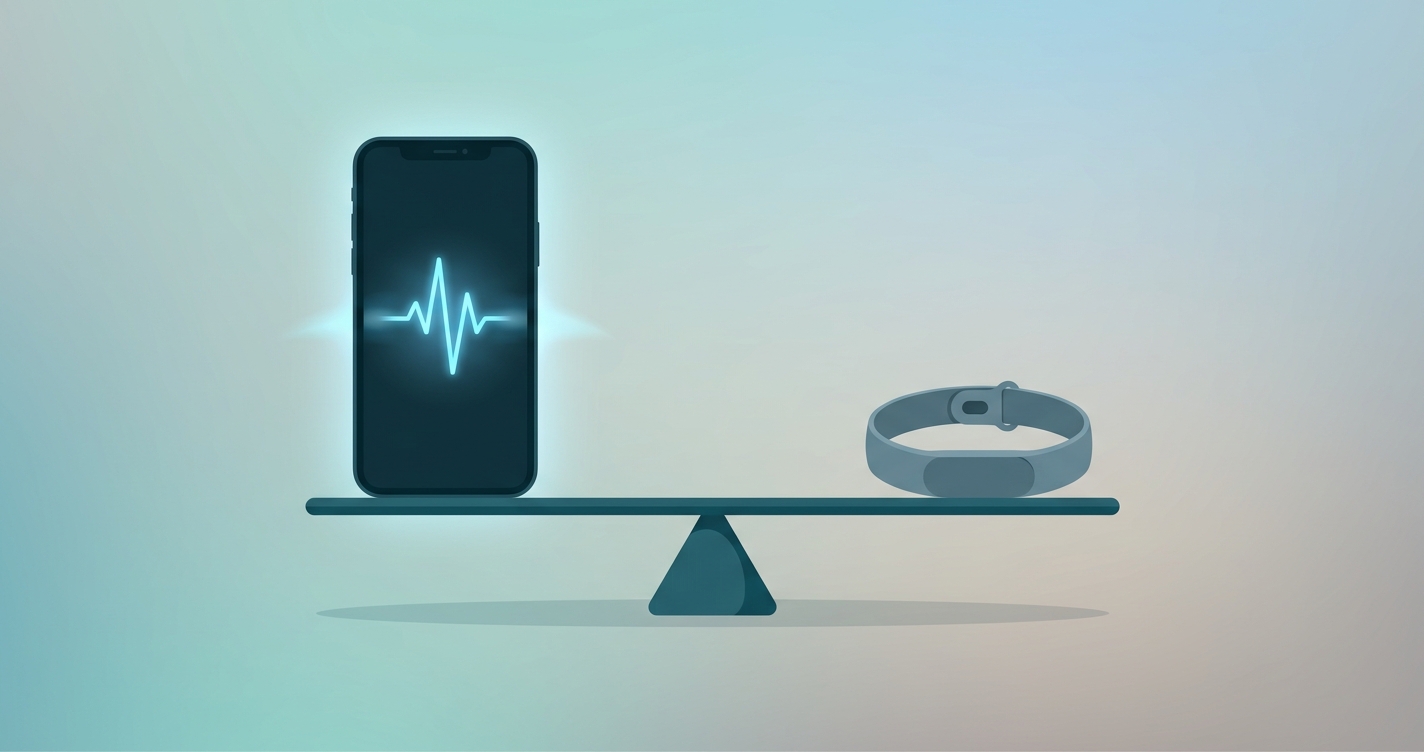
For most health-curious shoppers, the decision used to be simple: if you wanted to track your heart rate or sleep, you bought a wrist-worn band. That assumption is now worth re-examining. The debate over a contactless vitals app vs fitness tracker has become real because the front-facing camera on a phone you already own can estimate several vital signs without any hardware on your body. This shift matters most for budget-conscious people who are not sure they want to spend money on a device that may end up in a drawer.
The global fitness tracker market was valued at roughly $60.9 billion in 2024, yet survey data analyzed by Wellable and earlier Gartner research put wearable abandonment at around 30 percent, with up to 79 percent of owners reporting at least one unused device at home.
That gap between what people buy and what they keep using is the financial backdrop for this comparison. A wearable is a recurring purchase decision: you pay up front, you maintain it, and you replace it. A camera-based approach inverts that model by using sensors that ship inside every modern smartphone.
Contactless vitals app vs fitness tracker: how each one works
The core difference is the sensing method. A fitness tracker uses contact photoplethysmography (PPG), shining green LEDs into the skin at the wrist and reading reflected light to estimate pulse. A contactless vitals app uses remote photoplethysmography, or rPPG, which detects the same tiny color changes in the skin caused by each heartbeat, but through a camera at a distance rather than a sensor pressed against you. The signal is the same underlying physiology; the capture method is what separates the two categories.
That distinction drives everything downstream. A wrist device measures continuously because it is strapped on, but only where it sits and only when worn correctly. A phone vitals app vs fitness band trade-off is essentially continuous-but-narrow data versus on-demand-but-broad readings. Neither is universally better. They answer different questions.
| Factor | Contactless Vitals App | Fitness Tracker |
|---|---|---|
| Up-front cost | Free to low (uses existing phone) | Typically $50 to $300+ |
| Hardware to buy | None | Band or watch plus charger |
| Comfort | Nothing worn on body | Worn on wrist day and night |
| Measurement style | On-demand spot checks | Continuous while worn |
| Typical metrics | Heart rate, HRV, respiratory rate, stress estimates | Heart rate, steps, sleep, activity |
| Battery burden | Phone only | Separate device to recharge |
| Adherence risk | Open app when needed | ~30% abandonment reported |
| Best for | Trend checks without commitment | All-day activity and sleep logging |
What a camera health app vs tracker actually measures
The camera health app vs tracker question often comes down to which numbers you care about. Contactless apps are strong at quiet, seated spot checks:
- Resting and on-demand heart rate
- Heart rate variability, a marker of recovery and stress balance
- Respiratory rate from subtle chest and color signals
- Stress or readiness estimates derived from the above
Fitness trackers add metrics that depend on being worn continuously:
- Step counts and movement throughout the day
- Sleep staging across a full night
- Workout heart rate during motion
- Long-duration trend lines without any user action
The honest summary is that the two overlap on heart rate and diverge almost everywhere else.
Industry applications and buyer scenarios
The budget-conscious first-timer
For someone who simply wants to know whether their resting heart rate is elevated this week, no wearable health monitoring removes the purchase risk entirely. There is no device to abandon because there is no device. Given that abandonment hovers near 30 percent, the financial logic of starting with software is straightforward: try the measurement before committing to hardware.
The all-day activity tracker
People training for events or counting steps genuinely benefit from continuous wrist data. A band that logs every workout and every night of sleep does something a spot-check app cannot. For this buyer, the wearable earns its cost through volume of passive data.
The household and caregiving use case
Camera-based readings scale across people. One phone can take a reading for several family members because nothing has to be fitted, charged, or sized to a wrist. For caregivers checking on an older parent, the contactless model avoids the friction of asking someone to wear and maintain a gadget.
Current research and evidence
The accuracy question is where buyers should be most careful, and the research is encouraging for resting conditions. A 2024 scoping review published in Frontiers in Physiology examined resting heart rate from smartphone-based photoplethysmography against electrocardiography and reported good to very strong agreement in healthy subjects under controlled conditions. Validation work on rPPG-enabled smartphone applications, including a study of the WellFie application published on medRxiv, reported heart rate accuracy above 97 percent and respiratory rate accuracy above 84 percent, with mean absolute errors for heart rate often below 3 beats per minute.
Deep learning research has pushed those numbers further. Work published on arXiv on heart rate and respiratory rate prediction from noisy real-world smartphone video reported mean absolute errors as low as 1.73 and 2.49 beats per minute in some models, and respiratory rate errors under 1 breath per minute in several studies. The consistent caveat from these researchers is that motion and lighting degrade rPPG signals, which is why contactless apps perform best during a still, well-lit seated reading rather than mid-run.
Wearables face their own evidence limits. A systematic review and meta-analysis on the real-world accuracy of wearable activity trackers for detecting medical conditions, indexed on PubMed, found meaningful variability once devices leave the lab and enter daily life. In other words, neither category is flawless outside controlled settings, and both deserve to be read as trend tools rather than diagnostic instruments. The American College of Sports Medicine again named wearable technology its top fitness trend for 2024, confirming demand even as accuracy debates continue.
The future of contactless and wearable health tracking
The trajectory points toward convergence rather than a single winner. Phone processors keep getting faster at running rPPG models, which widens what a camera can estimate from a short clip. Market forecasts from Grand View Research project the fitness tracker segment reaching roughly $162.8 billion by 2030 at an 18 percent compound annual growth rate, so wearables are not disappearing. What is changing is the entry point. Software-first measurement lowers the bar to trying health tracking at all, and many people will start with a camera scan and only later decide whether continuous wrist data justifies the hardware.
The likely outcome is a layered model: contactless spot checks for everyday curiosity and quick trend reads, with wearables reserved for those who want continuous and motion-based logging. For budget-conscious readers, that layering means the smart first move is the free one.
Frequently asked questions
Is a contactless vitals app as accurate as a fitness tracker?
For a still, seated resting reading, peer-reviewed studies report strong agreement between smartphone rPPG and reference methods, often within a few beats per minute. Fitness trackers hold an edge during motion and continuous overnight monitoring. Both should be treated as wellness trend tools, not medical devices.
Why choose a phone vitals app over buying a fitness band?
Cost and commitment. A contactless app uses sensors already in your phone, so there is nothing to buy, charge, or wear. With wearable abandonment reported near 30 percent, trying software first lets you confirm you will actually use health tracking before spending on hardware.
What can a fitness tracker measure that a camera app cannot?
Continuous all-day metrics. Because it is worn constantly, a tracker logs steps, full-night sleep staging, and workout heart rate during movement. A camera app is built for on-demand spot checks rather than uninterrupted background recording.
Can I use both together?
Yes, and many people do. A practical pattern is using a contactless app for quick morning readiness and heart rate variability checks while relying on a band for activity and sleep. Starting with the free app first is the lower-risk way to learn what you actually need.
Circadify is addressing exactly this space by letting people check vital signs with the camera they already carry, before deciding whether any wearable is worth the cost. If you want to test contactless measurement without buying hardware, you can try Circadify free.