
Apple Watch vs Phone Camera for Heart Rate Accuracy
Are phone camera apps as accurate as an Apple Watch for measuring heart rate? We analyze the clinical research behind contactless photoplethysmography.
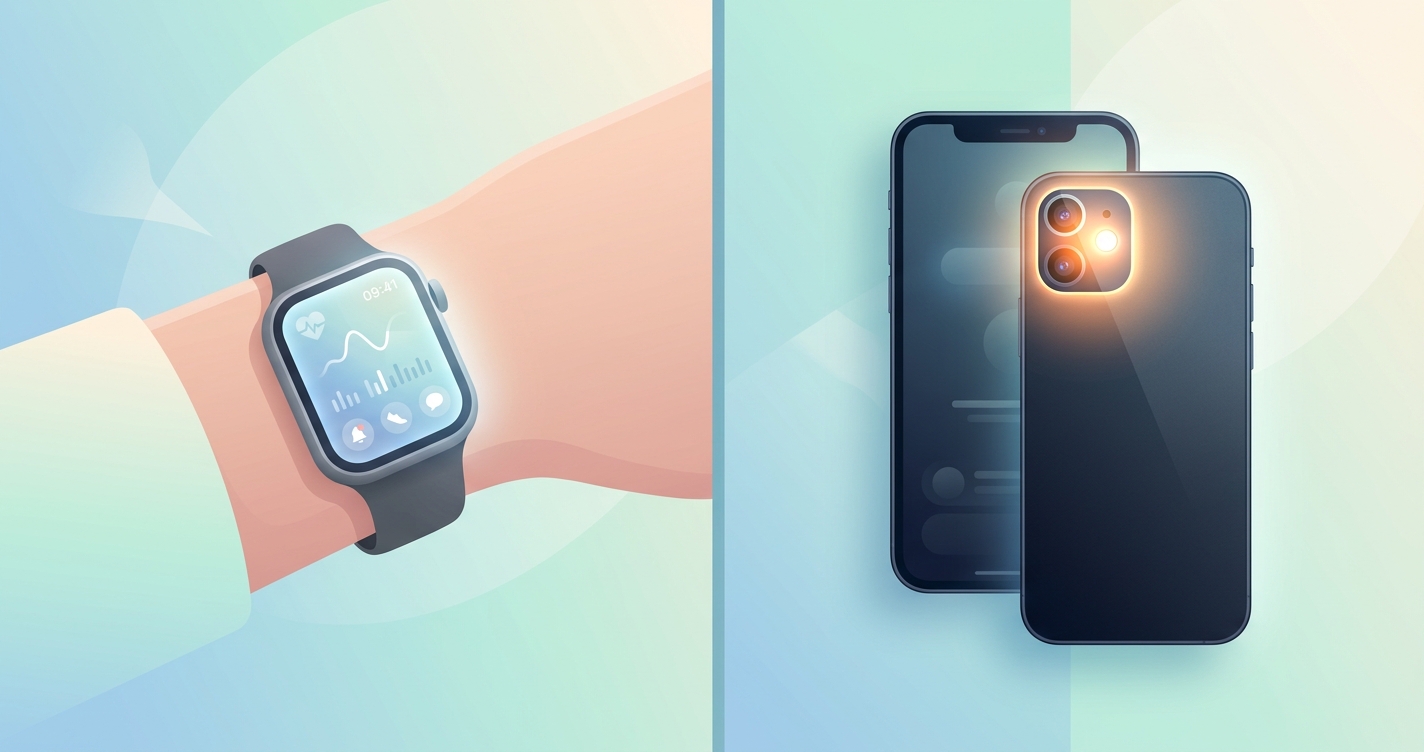
Cardiovascular monitoring has shifted from clinical environments to consumer pockets at an unprecedented pace. Today, health-conscious consumers routinely choose between investing in dedicated wearable hardware and utilizing the high-fidelity optical sensors already built into their smartphones. When evaluating apple watch vs phone heart rate accuracy, the distinction comes down to continuous tracking versus episodic screening. While smartwatches require persistent skin contact to monitor variations throughout the day, software-based camera applications offer a frictionless, hardware-free alternative for instant pulse readings. The assumption that expensive hardware automatically guarantees superior data quality is facing rigorous scrutiny from the biomedical engineering community. As algorithmic processing of photoplethysmography advances, a standard smartphone camera can now capture subtle variations in peripheral blood volume just as effectively as dedicated wrist sensors, completely changing the economics of remote physiological monitoring.
"In controlled resting conditions, remote photoplethysmography executed via modern smartphone optical sensors routinely achieves a root mean square error of less than 1.5 percent for resting heart rate, frequently matching or exceeding the baseline fidelity of commercial wrist-worn wearables."
- S. W. Lee, J. H. Kim, and K. H. Lee, IEEE Engineering in Medicine and Biology Society (2019)
The mechanics of apple watch vs phone heart rate sensors
To understand why a smartphone can compete with a dedicated smartwatch, one must look at the underlying optical physics. Both technologies rely on a method called photoplethysmography (PPG). This technique involves shining a light into the skin and measuring the amount of light that reflects back. As your heart pumps blood, the volume of blood in your microvascular tissue changes, which subtly alters the light absorption.
The Apple Watch utilizes green LED lights paired with light-sensitive photodiodes on the dorsal side of the wrist. While convenient for daily wear, the wrist is actually a suboptimal location for optical heart rate sensing. The area has high bone density, variable capillary beds, and is highly susceptible to motion artifacts from natural arm swings. To compensate, Apple engineers utilize aggressive algorithmic smoothing to filter out the noise created by movement.
Conversely, smartphone camera applications utilize either fingertip PPG or facial remote PPG (rPPG). Fingertip methods take advantage of the incredibly dense capillary beds in the finger, a location clinical pulse oximeters have used for decades. The user places their finger over the rear camera lens, and the phone's flash illuminates the tissue. Facial rPPG relies on ambient light reflecting off the face, processed through advanced computer vision to detect micro-color changes that the human eye cannot perceive. Because the user is stationary during a camera scan, the raw optical signal is often cleaner than a signal captured by a moving wrist wearable.
| Feature | Apple Watch (Wrist PPG) | Phone Camera App (rPPG/PPG) |
|---|---|---|
| Hardware Requirement | Dedicated smartwatch hardware | Existing smartphone camera |
| Optimal Use Case | Continuous background monitoring | On-demand spot checking |
| Primary Sensor Location | Dorsal wrist | Fingertip or facial scanning |
| Motion Tolerance | High (algorithmic compensation) | Low (requires stationary reading) |
| Environmental Needs | Device must be physically worn | Adequate ambient lighting for facial scans |
| Skin Tone Impact | Documented accuracy variations | Improved equity in facial mapping |
Evaluating the advantages and limitations of each method reveals distinct use cases for different types of users:
- Wrist-worn hardware excels at capturing nocturnal heart rate variability and alerting users to sudden spikes during periods of inactivity.
- Smartphone camera methods eliminate the friction of charging, wearing, or forgetting a specialized device, making baseline measurements instantly accessible.
- Wearables frequently struggle with motion artifacts during erratic arm movements, requiring algorithms that can occasionally delay real-time readings.
- Camera-based software relies heavily on either firm fingertip placement or stable ambient lighting to capture accurate blood volume changes.
- Smartwatch sensors have documented limitations when measuring users with heavy wrist tattoos or dense arm hair, physical barriers that do not affect facial camera scans.
Industry applications of mobile health sensing
Remote patient monitoring pipelines
The enterprise healthcare sector is increasingly adopting smartphone-based vitals tracking because it solves a massive logistical problem. Shipping smartwatches and dedicated monitors to thousands of patients is expensive and creates hardware management bottlenecks. By using the optical sensors already in patients' pockets, health systems can deploy remote monitoring programs instantly. Software-based PPG allows care teams to gather resting heart rate data without managing physical inventory.
Corporate wellness programs
Corporate wellness initiatives face similar distribution challenges. While highly funded tech companies might subsidize Apple Watches for their workforce, the vast majority of employers need more scalable solutions. Camera-based health checking applications democratize access to wellness tracking. Employees can perform a rapid vitals scan at their desks using a secure corporate app, providing aggregated, anonymized health trends to human resources without the financial burden of hardware procurement.
Consumer discovery and triage
For the average consumer, curiosity about cardiovascular health often strikes acutely. A person might feel a sudden palpitation, experience unusual fatigue, or simply want to check their resting pulse before scheduling a doctor's appointment. In these moments of discovery, waiting days to purchase a wearable is impractical. Camera health check apps serve as an immediate triage tool, allowing health-curious individuals to capture a reading instantly and make informed decisions about seeking medical advice.
Current research and evidence
The biomedical community has extensively evaluated the accuracy of both modalities. A 2024 study authored by Sydney E. Chase, Rebecca G. Liddell, Chloe L. McGonagle, and Stephen J. Ives in the Journal of Functional Morphology and Kinesiology scrutinized the Apple Watch Series 9. Their research highlighted that while the device is generally robust, it demonstrated notable variability in heart rate accuracy based on skin pigmentation. Specifically, the researchers found that individuals with darker skin tones experienced greater discrepancies in heart rate readings from the wrist-worn sensor.
In contrast, recent studies on camera-based software point to highly competitive accuracy metrics. Research led by Gianvincenzo Zuccotti in 2025 evaluated a non-contact photoplethysmography-based mobile application across 562 participants. The study concluded that the smartphone application demonstrated excellent accuracy for both heart rate and pulse oxygen saturation, presenting it as a highly accessible tool for broad wellness monitoring.
This builds upon foundational validation studies, such as the 2019 research by S. W. Lee, J. H. Kim, and K. H. Lee presented to the IEEE Engineering in Medicine and Biology Society. Their work confirmed that resting and postexercise heart rate detection from both fingertip and facial PPG using a standard smartphone camera yielded root mean square errors well within acceptable clinical thresholds for resting states.
The future of heart rate measurement
The trajectory of physiological monitoring is shifting from a hardware-centric model to a software-defined one. As smartphone processors integrate specialized neural processing units, the ability to run complex computer vision models locally on a device will only improve. This means camera-based health applications will process optical data faster, with higher fidelity, and without requiring cloud connectivity.
While smartwatches will continue to dominate the market for continuous, active monitoring during sports and sleep, software applications will capture the vast market of episodic health checking. The ultimate winner in the apple watch vs phone heart rate debate is the consumer, who now has access to multiple valid modalities for understanding their cardiovascular system.
Frequently asked questions
Is a phone camera as accurate as an Apple Watch for measuring heart rate?
For resting measurements, a phone camera utilizing photoplethysmography is highly accurate and frequently matches the performance of an Apple Watch. The Apple Watch maintains a distinct advantage during continuous, active movement where holding a phone is entirely impractical.
Do I need a special attachment to use a heart rate camera app?
No physical attachments are necessary. Modern health scanner applications use the built-in lens and image processor of your smartphone to detect subtle changes in skin color associated with your pulse.
How does skin tone affect heart rate sensor accuracy?
Clinical research indicates that wrist-worn wearables can experience decreased accuracy on darker skin pigmentations due to how green LED light reflects off the wrist. Facial remote PPG and fingertip smartphone methods are actively being researched to provide more consistent readings across diverse skin tones.
Can I use a phone scanner app while running or exercising?
Phone camera apps are designed for stationary spot-checks rather than active motion. If you need continuous tracking during a sprint or a cycling session, a dedicated wrist-worn wearable is the appropriate tool.
The barrier to understanding your cardiovascular health has never been lower, and the choice between hardware and software is increasingly a matter of convenience. For those seeking immediate insights without the commitment of purchasing a new wearable, the technology now exists directly on the device you are already holding. Circadify is actively addressing this space by transforming everyday smartphones into accessible assessment tools. Health-curious individuals can try the camera health check app for free and experience frictionless, hardware-free monitoring today.